
1 in 5 insurance claims gets denied.
Your Lakehouse can appeal them in minutes.
Draft a fully sourced, data-backed appeal letter in minutes,
using the data already sitting in your Databricks Lakehouse.

Executive Dashboard
Denials, resolution time, and revenue recovered across all payers.
Days Revenue Outstanding
0
Avg. age of open claims
Denial Rate
0%
Clean Claim Rate
0%
No flags on submission
Revenue at Risk
$0
High-risk, pending 30+ days
Revenue Recovered (MTD)
$0
Avg. Days to Resolution — by month
By month claims were submitted, not a live daily AR snapshot
Denial Rate Trend
% of claims flagged high-risk, by submission month
THE PROBLEM
The appeal data is already there,
but claim denials still pile up.
Most health systems already have claims data parsed in their Lakehouse. What's missing is a workflow
that catches denials before they happen and clears the ones that do.
📄
Appeals are written from scratch
Each one takes a biller about 38 minutes: pulling the claim, finding the chart, writing it by hand.
📈
Data fragmented across systems
Remittance in one system, claims in another, clinical docs in the EHR. No one sees the full picture at once.
📊
Filing windows expire quietly
Without automated tracking, denials age past their appeal window. Once it closes, that revenue is gone for good.
THE SOLUTION
A live claims workbench that
reads the
denial and drafts the appeal.
SunnyClaims reads the denial, decodes it, and drafts a fully cited appeal, ready for the biller to verify and send.
38 min → 4 sec draft time · 12 → 47 appeals per biller per day · 44% → 74% appeal success rate.
AI Appeal Drafting
Drafts are grounded in each claim's own clinical notes, denial reason, and payer rules — nothing invented. Every appeal goes through human review before it leaves the workbench.
CLM-8028 · Maria Murphy · UnitedHealth Group
Billed
$14,374.91
CPT / ICD-10
20610 · M25.561
Age
386d
Denial Code
CO-97 · NCCI bundling
Draft Appeal Letter
Denial received
835 remittance parsed. Instead of codes (CO-50) you get plain language "Not medically necessary".
Claim + docs pulled
837 retrieved from Delta Lake. Clinical notes, imaging, and PT records read directly from Unity Catalog.
Appeal drafted
A complete, medically-cited appeal letter, with every fact traceable to a specific source document.
Biller approves
The biller verifies the citations and submits.
USE CASES
Beyond appeal submission.
Ask about claims, denials, or revenue
Plain language in, real SQL out — every response shows the query that produced it.
silver.claims, silver.appeals, or silver.payer_rules. I'll show the SQL I ran alongside every answer.
Pre-Denial ML
Stop the denial before it leaves the building.
A model trained on your historical denials flags high-risk claims before submission, so coders can fix modifier errors and mismatches first.
30–50% reduction in denial rate.
Denials Workbench
One prioritized queue.
Denials decode into plain language automatically, with filing deadlines counting down in plain sight.
Nothing expires unnoticed
Ask Genie
No SQL, no ticket, no wait.
CFOs and RCM directors ask questions in plain language and get governed answers straight from Unity Catalog.
No more engineering dependency
BUSINESS RESULTS
Recover revenue with faster appeals.
For a mid-size health system, denials cost 4–6% of net patient revenue every year.
Once a claim ages past its appeal window, that revenue is gone for good.
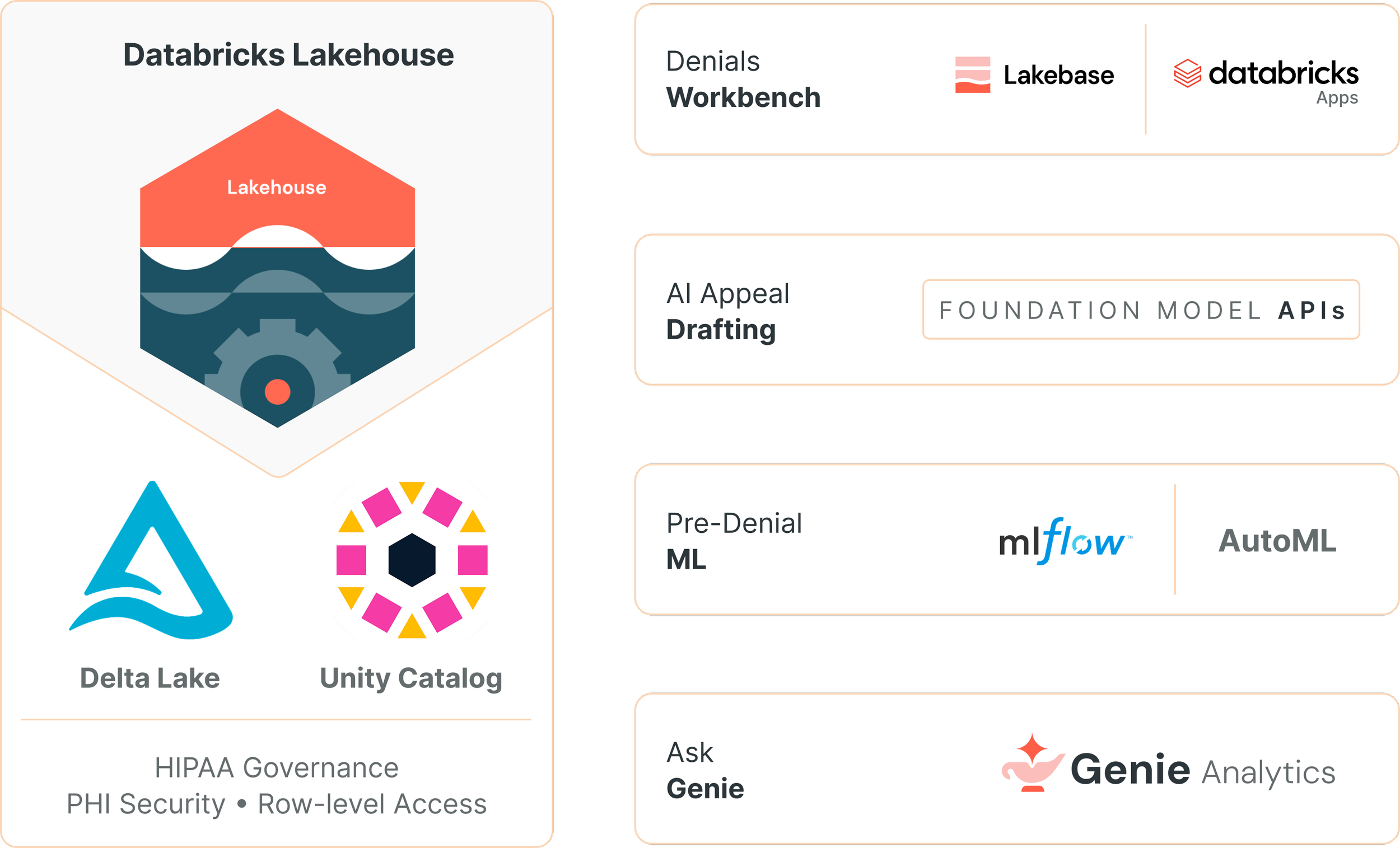
BUILT ON DATABRICKS
Everything runs within a secure
Unity Catalog environment.
No new platform. No migration. Every module runs on components already in your Lakehouse.

Give us 20 denials. We'll show you the difference.
Talk to our team about a 2-week proof of value on your own Databricks environment.